

The beginning, project CarbonOne
Exactly three years ago, on January 13th, 2023, I published a blog post about the CarbonOne project.
In fact, I built my first wheels with carbon spokes for myself back at the beginning of 2022. At the time, these were the first carbon spokes available for non-system wheels. In general, this was not the beginning of carbon spokes on the market, as brands such as Mavic or Lightweight had been building such wheels for many years.
So what made the CarbonOne project spokes different? The key difference was the ability to use virtually any hub, because on the hub side these spokes had exactly the same dimensions as traditional steel spokes.
The project sparked huge controversy. Most people claimed that carbon spokes would never work. Today, three years later, practically all major companies have introduced such wheels into their offerings — including DT Swiss.
However, there is one crucial factor that determines whether such wheels will be better or worse than traditional ones, and that is what today’s post is about.

Advantages of carbon spokes - stiffness
The most problematic wheel is always the rear wheel. The cassette and the disc brake mounting significantly limit the flange spacing of the hub, which means that the geometry of the rear hub is of crucial importance. A poorly designed hub results in a wheel with very low lateral stiffness, causing it to flex sideways, particularly during climbs.

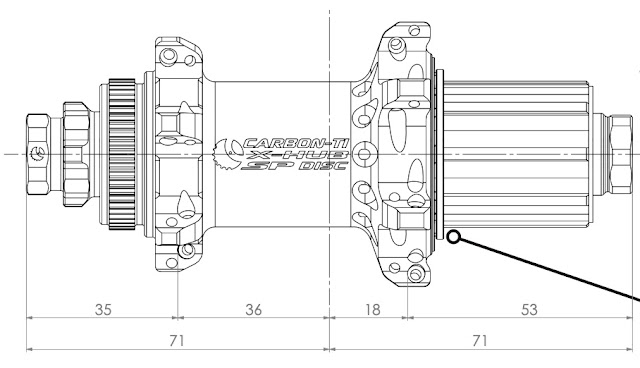
This can be mitigated by using a higher number of spokes or a deeper rim profile, but in my case I wanted to use one type of hub for 30, 40, and 50 mm rim depths. A higher number of carbon spokes was not an option.

Carbon spokes in practice
Breaking new ground since 2022, many sets of CarbonOne wheels have made their way to various countries around the world, as far away as Japan.


On the downside, CarbonTi hubs have adjustable bearing preload and, unfortunately, require fairly frequent checks. Neglecting this leads to relatively quick bearing failure. When replacing bearings, I use higher tolerance ABEC-3 bearings, which significantly extends their service life to a full season or even longer. This applies to CarbonTi hubs in general, regardless of whether they are used in CarbonOne wheels or any others.
Bearing preload should be checked regularly, especially if you hear the brake rotor rubbing against the pads. In such cases, the play should be eliminated as soon as possible. When replacing bearings, I recommend Enduro ABEC-3, MAX version. Those last much longer than the stock SKF bearings installed by CarbonTi.


Does this disqualify the carbon spoke project? Of course not!
New adhesive-free spoke technology. The game changer


Project CarbonOne v2
Having already more than four years of experience with carbon spokes, I naturally built wheels using these spokes. The new project was not easy at all. The new spokes are incredible and there is no question of the joint failing, but at the same time they have a much larger end diameter on the hub side, which makes it impossible to use standard hubs.
Many hub manufacturers have adapted a typical hub to the new spoke standard. However, in my opinion, many of them have done this completely wrong. Why? I’ll explain in a moment…
Typical 1:1 hubs for carbon spokes look like this:

As you can clearly see, the hub flanges have been widened to accommodate the thicker spokes. The distance of the left flange from the center is 33 mm, while the right one is just under 16 mm. Since the hub cannot be widened outward, space has to be taken from the center. Such narrowly spaced flanges result in a very - extremely low lateral stiffness of the rear wheel. On every climb, the rear wheel will flex significantly from side to side, especially with a lower rim depth.
This kind of approach completely disqualifies wheels built with carbon spokes, and in my opinion, you should avoid such wheels altogether.
So how should it be done properly? There is only one answer: triplet hubs.


I have been using the 16:8 / 14:7 lacing pattern for a long time now. For those who follow this blog, I also build very similar wheels with steel spokes - there is an entry about that here.
By using a triplet setup with carbon spokes, we obtain incredibly stiff and responsive wheels that transfer all the power from the cranks directly into acceleration, while at the same time remaining very comfortable. Riding on poor-quality asphalt or gravel is truly much more pleasant than on steel spokes.
Such hub geometry and this type of lacing give us a wheel with the best possible parameters. Campagnolo and Fulcrum have been using this lacing pattern for many years. Wheels from these manufacturers are renowned for their excellent stiffness, and that hardly needs any advertising.

The graphic design is new. I spent a long time thinking about how to combine a matte finish with gloss… and here is the result:


CarbonOne 2 and riding impressions
How do these wheels ride? Well, like this:


I used 21/21 spokes for the CarbonOne road wheels, with a 14:7 triplet lacing, two-cross/radial, and 24/24 spokes for the CarbonOne gravel wheels, 16:8 triplet, two-cross/radial on the front and two-cross/two-cross on the rear.
The road version has a 22 mm internal rim width with depths of 30/40/50 mm, while the gravel version comes in 25 or 27 mm internal width with a 40 mm depth.
If you want truly high-quality wheels with carbon spokes, built 100% by hand in Poland Wrocław, you’re very welcome to get in touch. Contact via email: [email protected] or through CarbonOne.pl. The wheels are built with great precision: 0.5 mm lateral runout, 1 mm vertical runout. A tensiometer calibrated specifically for carbon spokes ensures a real and correct spoke tension of 110 kg.

A final word
Good wheels with carbon spokes mean only one thing: triplet. Vonoa spokes provide a 100% guarantee of quality and safety, and those are the wheels you should be looking for.
Tomek.

No comments:
Post a Comment